
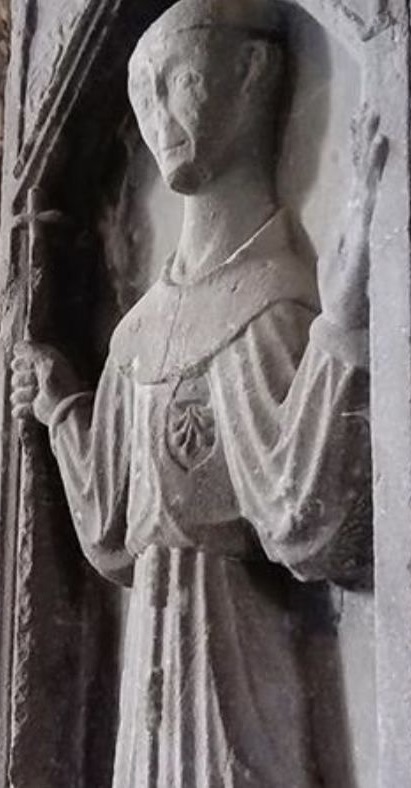
The image here is recognizably Saint Francis of Assisi. It is late-medieval and is located in the old Friary of Ennis, County Clare (c. 1240). This limestone effigy was once part of a larger altarpiece, now sadly lost. Saint Francis, stands upright, holding a preacher’s staff with a small cross on the top. These preacher’s staffs were carried by the friars on the preaching tours around the country.
There is another representation of Saint Francis with a preaching staff in the now ruined friary in Dromahair, County Leitrim. We see Saint Francis dressed in the habit of the Franciscans of Observant Reform; a tunic with a cord for a belt, the hood or capuche is a semi-circle over the shoulders and upper chest, leaving the arms free, and it tappers to point at the back.
The Observant Reform was one of many reform movements within the late-medieval Franciscan Order. The Observant Reform began in Italy in 1334 when the first group of the reformed Franciscan friars settled in the hermitage at Brugliano. At first the Observant friars tended to retreat to hermitages and remote places, but in time they were established in towns and cities also. By 1391 there were twenty-two Italian Franciscan houses following the Observant Reform. The Observant Reform reached Ireland in the 15th century. Interestingly, the impetus to adopt the Observant Reform didn’t always come from the friars themselves.
The Observant reform of Limerick Friary came in 1534, following a request by the mayor and corporation of the city to a provincial chapter. This is the only instance of a civic corporation intervening to secure reform in Irish context. Ennis Friary adopted the Observant Reform in 1540, at instigation of Murrough O’Brien and the chief men of Thomond. The Observant Reform put great emphasis on preaching the Word of God. Among the luminaries of this reform were Saint Bernardine of Sienna and Saint John of Capistrano.
The Observant Reform understood preaching to be of the greatest importance since, according to Saint Bernardine, preaching was the primary task given by Christ to the Apostles. The Apostles were sent out to the whole world to preach the Gospel, based on this commission, and secondary to it was the celebration of the sacraments. Just as the word of Christ raised to life the son of the widow of Nain, and Lazarus, so do the words of the preacher raise sinners to life; sinners are dead in as much as their lives are moving away from God and resisting God’s healing grace.
The voice of the Son of God (vox Filii Dei) in the Gospel becomes the word of God (Verbum Dei) of the preacher. The Observant friars saw as their task waking the dead (sinners) by means of the powerful Word of God. The fervent preaching of the Word of God is the occasion for a living visitation of Christ by means of the Holy Spirit, who pours out into the hearts of the faithful the overflowing love of God.
This elevated understanding of preaching characterised the Observant Reform. The Franciscans have traditionally valued the office of preaching, exercising this ministry in our friary churches, in parish missions, retreats, and especially the annual novena in honour of Saint Anthony. As society changes the opportunities to preach the Word are also changing. Many reach the Word today online and in a variety of forms of media communication.
To become a Franciscan presupposes an encounter with the Word of God; a Word that transforms and renews our lives. To bring the Word of God to others, to preach the Word, means to have been nourished by the Word. “Blessed is that religious who finds pleasure and delight in the most holy words and deeds of the Lord and with these, lead people to love God with gladness and joy”. St. Francis of Assisi, Admonition 20, 1-2.
If you are interested in the Franciscan way of life please contact:


